Species · genus Araucaria · Araucariaceae
Moreton Bay Pine
Araucaria cunninghamii Aiton ex A.Cunn.
Also known as: Colonial-pine · Dorrigo-pine · Hoop-pine · Queensland-pine · Richmond River-pine
Cultivars of A. cunninghamii
The named forms growers keep — each with its own page, each honest about how much we know.
No named cultivars catalogued under A. cunninghamii yet. When growers document a stable, named form, it earns its own page here.
Guide
The species-level account. Cultivar pages build on this and say where they differ.
The Moreton Bay Pine
Araucaria cunninghamii, also called hoop pine, is an upright, frost-tender conifer in the Araucariaceae family. Left to its own devices it grows into a large columnar tree, eventually rising well past 12 metres, with a spread of 4 to 8 metres.
Source: RHS
Native Range
This tree hails from New Guinea and eastern Australia, part of the Southern Hemisphere lineage of Araucaria species. Two varieties are recognised, var. cunninghamii and var. papuana, the latter also known by the synonym Araucaria beccarii.
Source: RHS
Site And Soil
Grow it outdoors in loam or sandy soil that is moist but well-drained, in full sun or partial shade, and give it shelter from frost and from cold, drying winds. It tolerates both acid and alkaline conditions and can face north or south, but its hardiness only extends to milder, coastal parts of the UK.
Source: RHS
From Seed Or Cutting
New plants are raised either from seed or from semi-ripe cuttings.
Source: RHS
Bark, Leaves, Cones
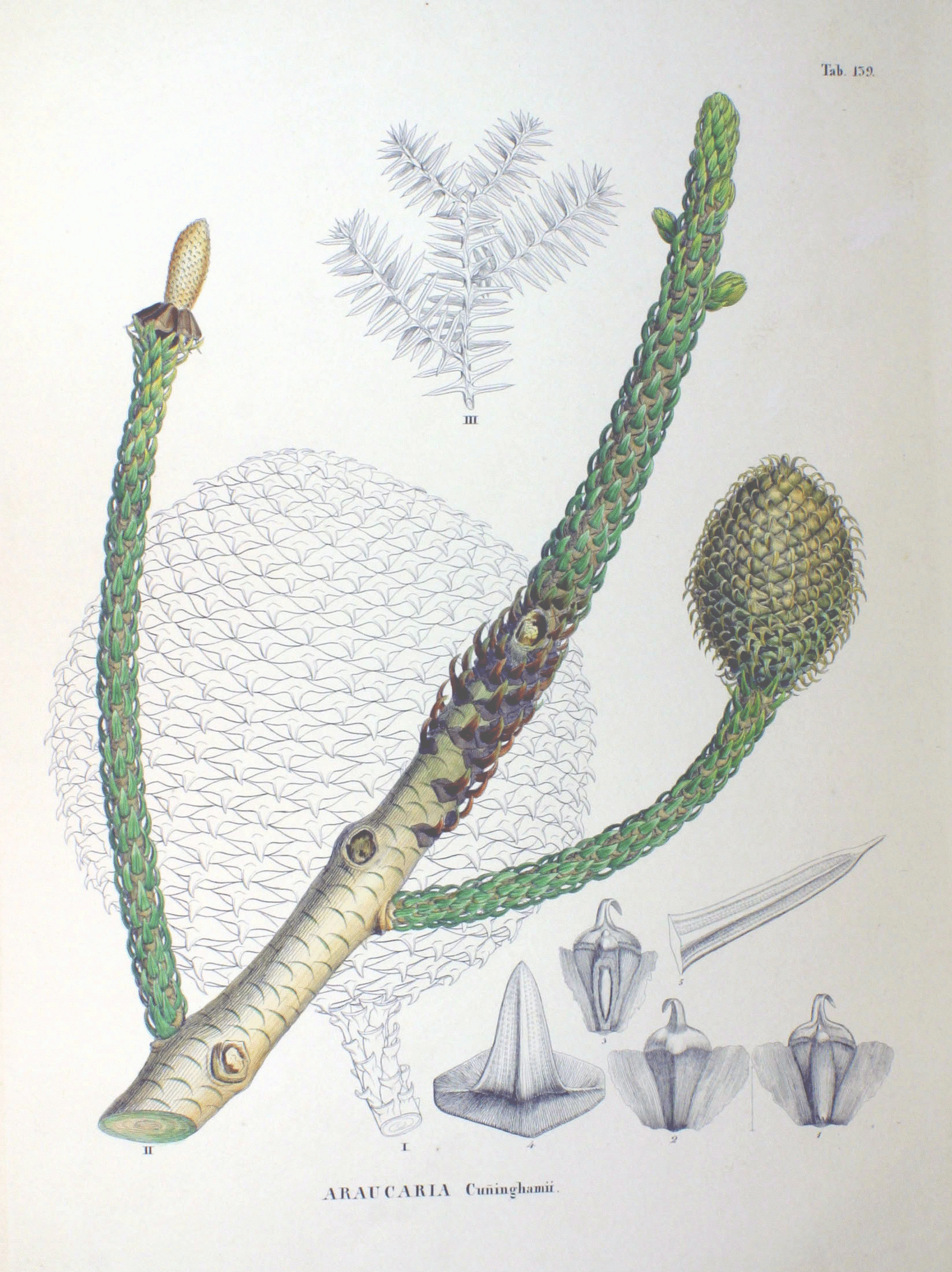
The bark is rough and reddish-brown, peeling away in circular bands as the tree matures. Young growth carries awl-shaped leaves up to 2cm long arranged in spirals, while adult foliage becomes scale-like and incurved. Mature trees bear small cylindrical male cones and larger ovoid female cones that break apart on ripening to scatter nut-like seeds.
Source: RHS
Largely Untroubled
This conifer is generally free of pest problems.
Source: RHS
Honey Fungus Risk
The main disease concern noted is susceptibility to honey fungus.
Source: RHS
Light Pruning Only
This tree falls into the light pruning group, needing little intervention once established. It is slow to reach full size, taking more than fifty years to mature, and suits low-maintenance, architectural planting positions.
Source: RHS
Care recipe
The species record — the baseline every cultivar inherits unless it says otherwise.
Care notes are early — not yet verified
- Light
- ai:claude-opus-4-8
- Water
- ai:claude-opus-4-8 (range 7-14d)
- Humidity
- ai:claude-opus-4-8
- Soil
- ai:claude-fable-5
- Care
- ai:claude-fable-5
Bright, indirect
≈ every 14 days
Medium
10–28 °C
Well-draining loam with added grit
Fresh seed
Light balanced feed in spring and summer
Moderate
Does not flower indoors; a tall, graceful conifer
Not yet documented
This is where toxicity lives — every cultivar of this species inherits it and none can override it.
Reference images
Every image credited. Licenses link to their deeds.
Sources: ai:claude-opus-4-8 · ai:claude-opus-4-8 (range 7-14d) · ai:claude-fable-5
Kept true by its growers
Every fact here carries its source. Grow Moreton Bay Pine yourself? What you’ve observed — how it drinks, how it holds its color, a name that’s off — and a clear photo of your plant are exactly what keep this page honest. Contributions are reviewed before anything changes.
Sign in to add what you know →