Species · genus Araucaria · Araucariaceae
Monkey Puzzle
Araucaria araucana (Molina) K.Koch
Also known as: Chilean Pine · Monkey Puzzle Tree · Chile Pine · Monkey-tail Tree · Monkeypuzzle Tree
Cultivars of A. araucana
The named forms growers keep — each with its own page, each honest about how much we know.
No named cultivars catalogued under A. araucana yet. When growers document a stable, named form, it earns its own page here.
Guide
The species-level account. Cultivar pages build on this and say where they differ.
A Living Fossil Conifer
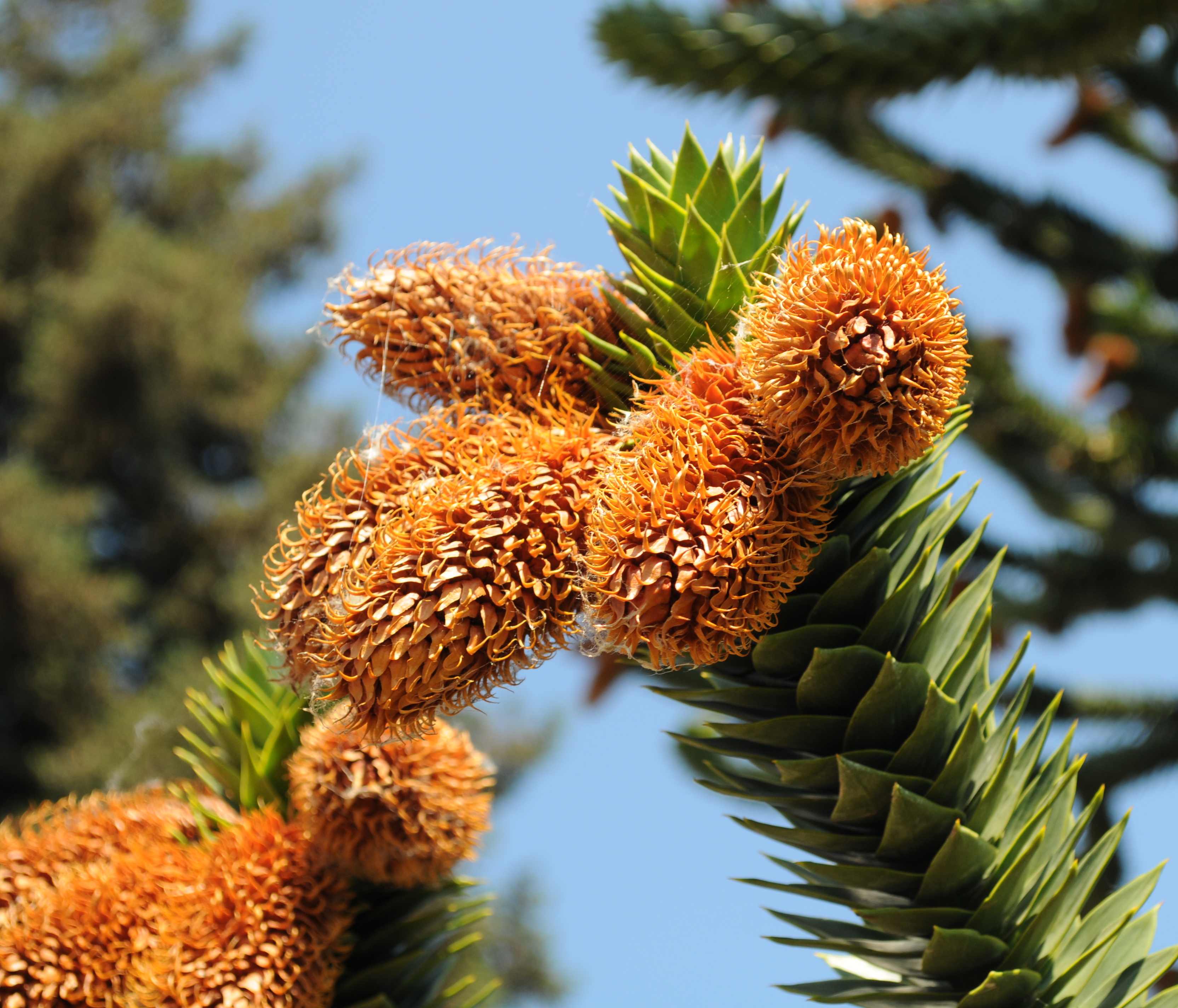
The monkey puzzle tree is a striking evergreen conifer, its whorled branches wrapped in dense, sharply pointed triangular leaves. It stands apart from most garden trees in both silhouette and age, having persisted on earth for hundreds of millions of years. Male and female cones usually appear on separate trees, on mature specimens only.
Source: Epic Gardening
Andean Volcanic Slopes
This species comes from the Andes mountains of Chile and Argentina, growing naturally on volcanic hills up to 6,000 feet, and it holds the honour of being Chile's national tree. It is one of roughly twenty species in the Araucaria genus and is considered among the hardiest. In its native range it can live for more than a thousand years, and its English name is said to trace back to a remark made in Cornwall in the mid-1800s that the tree's spiny branches would puzzle a monkey trying to climb it.
Source: Missouri Botanical Garden
Sun, Water, Patience
Give this tree full sun to partial shade, ideally somewhere it can catch at least eight hours of direct light a day, and set it in moderately fertile, moist but well-drained soil. It comes from a rainy mountain climate, so it wants plenty of water and should not be left to dry out for long, though the roots must never sit sodden. Feeding is rarely necessary, as the tree copes fine with poor soils, and if fertiliser is used at all a light application at the start of spring and again in early summer is enough. It tolerates a wide range of temperatures but appreciates shelter from cold, drying winds, and typical outdoor humidity suits it well.
Source: Epic Gardening
Seed, Cuttings, Layering
The traditional route is by seed, sown as soon as it is ripe in a seedbed, though seeds need weeks to months of cold stratification and can then take months more to germinate. Vertical shoot-tip cuttings taken in midsummer and rooted in a cold frame will grow into an upright tree, whereas cuttings from horizontal side branches will not. Air layering is another option for cloning an established branch without waiting on seed.
Source: RHS
Geometry In Green
The tree's defining trait is its pyramidal, open habit when young, with branches held apart from one another in a strikingly geometric arrangement, densely spiralled with stiff, leathery, triangular leaves that persist for ten to fifteen years apiece. As it ages it loses its lower branches and develops an umbrella-like crown atop a bare trunk of ridged grey-brown bark. Female cones take two to three years to mature before breaking apart to release large, edible, nut-like seeds known as pinones.
Source: Missouri Botanical Garden
Mostly Trouble-Free
This is generally a pest-resistant tree, but scale can appear as small bumps on the branches, slowing growth and yellowing the leaves. Indoors it may also pick up mealybugs, thrips, or spider mites, the usual houseplant hangers-on. Small infestations can be dabbed away with alcohol-soaked cotton or treated with a horticultural oil such as neem.
Source: Epic Gardening
Wet Feet, Dropped Branches
The biggest risk to this tree is overwatering, which brings on root rot and the fungal Phytophthora root rot, both worsened by poorly draining soil. Root rot shows as yellowing leaves and a foul smell from the soil, while Phytophthora causes drooping, curling leaves and darkened bark near the base. Low humidity can also crisp the leaf tips, and it is worth knowing that lower branches naturally brown and drop as the tree self-prunes with age, which is no cause for concern.
Source: Epic Gardening
Minimal Pruning Needed
This tree asks little in the way of upkeep once established. Only young specimens respond well to being cut back into older wood, and it falls into the light-pruning group, with most gardeners leaving the naturally geometric branching well alone. The main disease concern to watch for is honey fungus.
Source: RHS
Care recipe
The species record — the baseline every cultivar inherits unless it says otherwise.
Care notes are early — not yet verified
- Light
- ai:claude-opus-4-8
- Water
- ai:claude-opus-4-8 (range 10-18d)
- Humidity
- ai:claude-opus-4-8
- Soil
- ai:claude-fable-5
- Care
- ai:claude-fable-5
Bright, indirect
≈ every 18 days
Medium
5–22 °C
Gritty, sharply draining loam
Fresh seed
Sparse light feeding in spring and summer only
Slow
Does not flower indoors; prized for its architectural branches
Not yet documented
This is where toxicity lives — every cultivar of this species inherits it and none can override it.
Reference images
Every image credited. Licenses link to their deeds.
PrimarySources: ai:claude-opus-4-8 · ai:claude-opus-4-8 (range 10-18d) · ai:claude-fable-5
Kept true by its growers
Every fact here carries its source. Grow Monkey Puzzle yourself? What you’ve observed — how it drinks, how it holds its color, a name that’s off — and a clear photo of your plant are exactly what keep this page honest. Contributions are reviewed before anything changes.
Sign in to add what you know →