Species · genus Anthurium · Araceae
Crystal Anthurium
Anthurium crystallinum Linden & André
Also known as: Scalloped Laceleaf
Cultivars of A. crystallinum
The named forms growers keep — each with its own page, each honest about how much we know.
No named cultivars catalogued under A. crystallinum yet. When growers document a stable, named form, it earns its own page here.
Guide
The species-level account. Cultivar pages build on this and say where they differ.
A Crystal-Veined Aroid
Anthurium crystallinum, the crystal anthurium, is an evergreen perennial of the arum family grown chiefly for its foliage rather than its flowers. It carries large, velvety, heart-shaped leaves marked with pale to silvery veins, a look distinctive enough to set it apart from its Monstera and Philodendron relatives. It is considered a somewhat rare houseplant, and the RHS has recognised it with an Award of Garden Merit.
Source: Epic Gardening
Out of the Rainforest
This species comes from the tropical forests of Central and South America, found from Panama through to Peru and Colombia, where it grows as an epiphyte close to trees. In the wild it climbs trunks to escape competition and reach better light. The wider Anthurium genus was documented in 1876 by French botanist Eduard Andre, who brought many such tropical plants back to Europe, though little specific history survives about the crystal anthurium itself beyond its later cultivation there.
Source: Epic Gardening
Warmth, Shade, Moisture
Give this plant bright but indirect light, such as an east- or west-facing window, since direct sun scorches the sensitive leaves. Water freely through the growing season and only sparingly in winter, letting the top couple of inches of mix approach dryness between waterings, and keep the plant above 18°C with high humidity around it. Feed with an orchid fertiliser roughly every two weeks from spring to autumn, easing off once the season turns cold.
Source: RHS
Division, Cuttings, or Seed
Propagate by dividing an established clump, by taking stem or rhizome cuttings, from offsets in spring or summer, or by sowing fresh seed at a warm 24-27°C. Division and stem cuttings tend to be the more reliable, less fiddly routes for a home grower. Whichever method is used, care around the sap is worth taking, since it can irritate skin.
Source: RHS
Velvet Leaves, Silver Veins
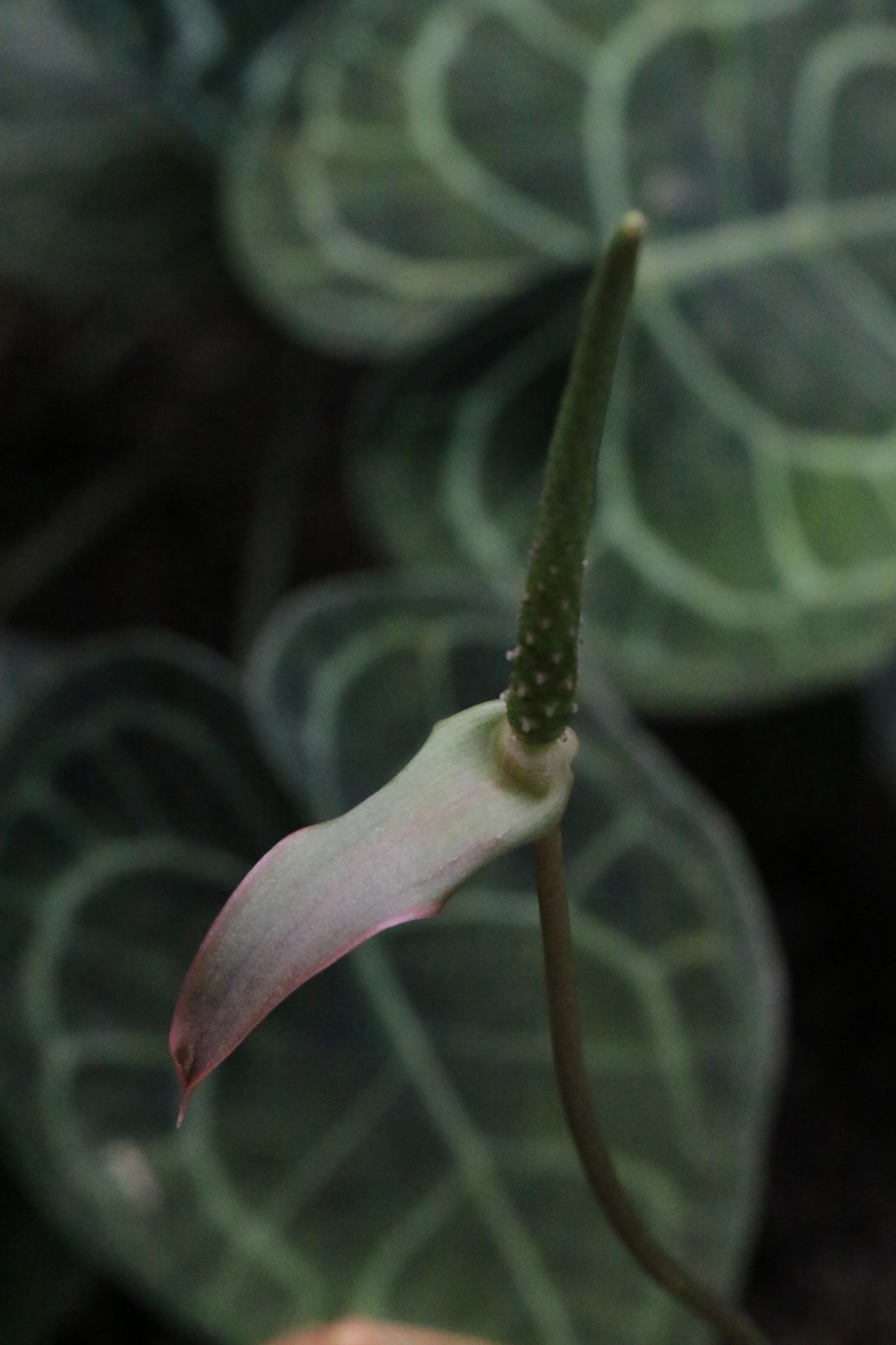
The defining trait of this plant is its broadly elliptic to heart-shaped leaf, dark velvety green and reaching up to about 45cm, with white main veins standing out sharply against the foliage. Younger leaves and the leaf undersides often take on a reddish or coppery cast. It flowers only intermittently, producing narrow green spathes to about 8cm with a yellow spadix, and its habit is clump-forming.
Source: RHS
Watch for Mealybugs and Scale
This anthurium can be susceptible to mealybugs and scale insects, both of which are worth checking for on stems and leaf undersides. Leaf spot is another disease risk, alongside root rot when the growing medium is kept too wet.
Source: RHS
Reading the Leaves
Browning of the leaves often points to air that is too dry, so raising humidity around the plant is the usual remedy. Leaf scorch tends to follow direct summer sun, while root rot traces back to overwatering or compost left waterlogged. Given adequate warmth, humidity, and acidic, free-draining compost, this species is generally an easy keeper with few problems.
Source: RHS
Little Fuss Required
This plant needs no routine pruning or training beyond removing dead leaves or spent flower stems at the base. It can generally stay in its original pot for a year or two before repotting is needed, after which every two to three years is a reasonable rhythm, moving up only one pot size to avoid overpotting and the wet compost that comes with it. Wear gloves when handling the plant, since its sap can irritate skin.
Source: RHS
Care recipe
The species record — the baseline every cultivar inherits unless it says otherwise.
Care notes are early — not yet verified
- Light
- ai:claude-opus-4-8
- Water
- ai:claude-opus-4-8 (range 5-10d)
- Humidity
- ai:claude-opus-4-8
- Soil
- ai:claude-fable-5
- Care
- ai:claude-fable-5
Bright, indirect
≈ every 10 days
High
18–27 °C
Chunky, airy aroid mix with bark, perlite and sphagnum
Division of the clump or basal offsets
Dilute balanced feed every 4-6 weeks in the growing season
Moderate
Grown for crystalline veined leaves; flowers inconspicuous
Toxic to cats & dogs & humans
Araceae contain insoluble calcium oxalate crystals, which cause oral and gastrointestinal irritation if chewed or ingested. This is where toxicity lives: every cultivar of this species inherits it and none can override it.
Reference images
Every image credited. Licenses link to their deeds.
PrimarySources: ai:claude-opus-4-8 · ai:claude-opus-4-8 (range 5-10d) · ai:claude-fable-5 · ai:claude-opus-4-8 (family inference)
Kept true by its growers
Every fact here carries its source. Grow Crystal Anthurium yourself? What you’ve observed — how it drinks, how it holds its color, a name that’s off — and a clear photo of your plant are exactly what keep this page honest. Contributions are reviewed before anything changes.
Sign in to add what you know →