Species · genus Anthurium · Araceae
Flamingo-Lily
Anthurium andraeanum Linden ex André
Also known as: Flamingo-flower · Oilcloth-flower · Anthurium · Painter's-palette
Cultivars of A. andraeanum
The named forms growers keep — each with its own page, each honest about how much we know.
No named cultivars catalogued under A. andraeanum yet. When growers document a stable, named form, it earns its own page here.
Guide
The species-level account. Cultivar pages build on this and say where they differ.
Flamingo Flower, Tropical Charmer
Anthurium is a genus of tropical evergreens grown for glossy foliage and long-lasting flower-like spathes in shades of red, pink, or white with a central spadix. Compact and colourful, it fits comfortably into most homes, usually reaching only about 30cm tall.
Source: RHS
From Rainforest Understory to Parlour
Anthuriums hail from Central and South America and parts of the Caribbean, where they grow wild as understory plants beneath the forest canopy, some rooted in soil and others living as epiphytes in the trees. Trinidad was once a major centre of cultivation in the twentieth century, growing them beneath cocoa and citrus orchards for the cut-flower trade, before the industry shifted to Holland and Hawaii in the 1970s and Jamaica became the leading exporter in the 1980s.
Source: Epic Gardening
Warmth, Light, and Careful Watering
Give anthuriums bright but indirect light, warmth of roughly 16-30°C, and steady humidity, since direct summer sun will scorch the leaves while too little light stops flowering. Water only once the compost is approaching dryness, using rainwater or filtered water at room temperature rather than cold tap water, and feed with an orchid fertiliser through the growing season from April to October. They need an open, fast-draining, peat-free acidic compost, and dislike being left sitting in soggy mix.
Source: RHS
Cuttings, Pups, and Water Rooting
A stem or rhizome cutting can be inserted into acidic compost and kept warm and humid until it produces new roots and shoots. Alternatively, a piece of stem bearing leaves and aerial roots can simply stand in water in a warm, bright spot until it roots, or a multi-stemmed plant can be pulled apart into separate rooted divisions. Offsets, or pups, are also easy to remove once they have grown their own aerial roots and a second leaf, making them a straightforward way to multiply a plant.
Source: RHS
Spathe, Spadix, and Glossy Leaves
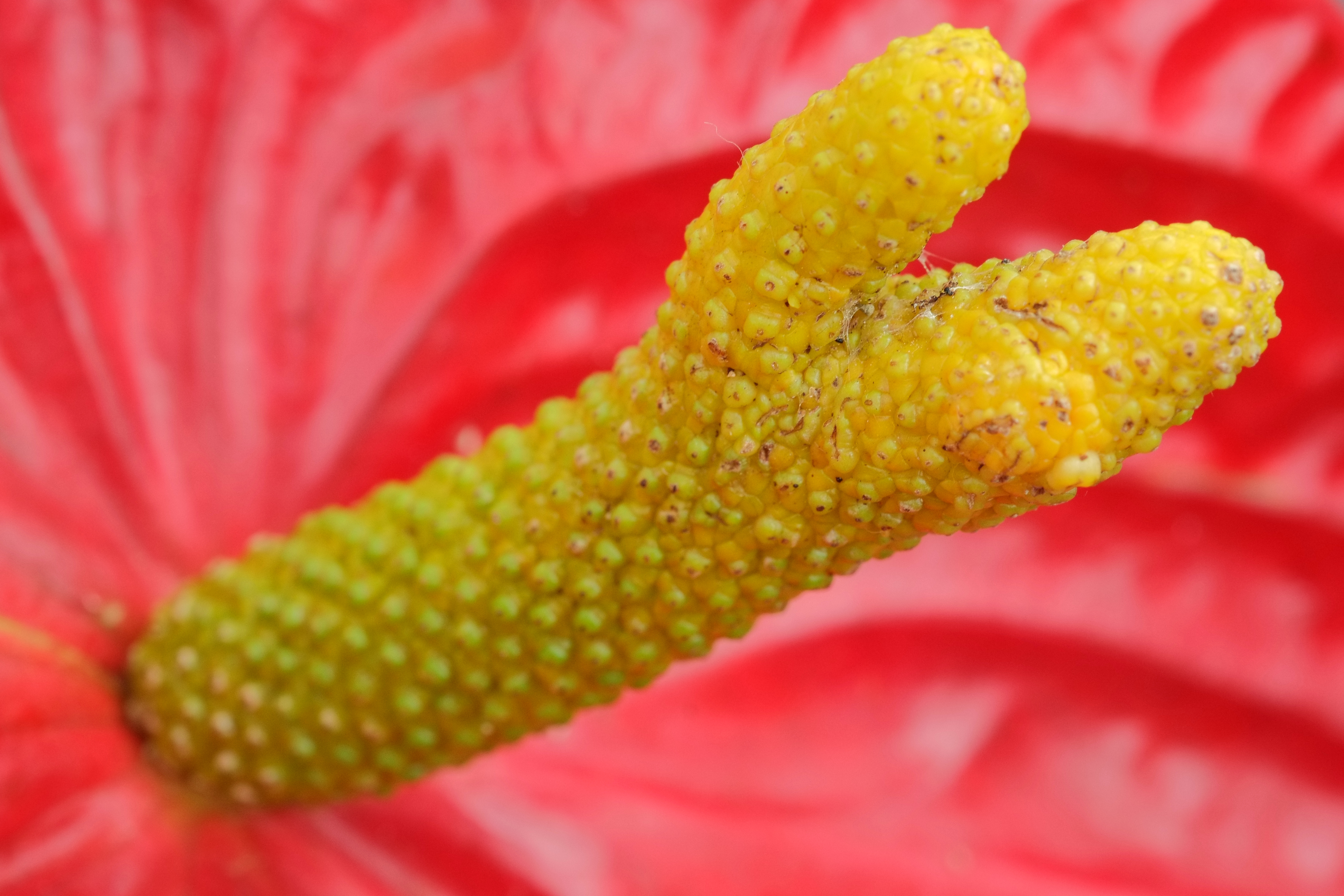
The plant's showy 'flower' is really a waxy, leaf-like spathe wrapped around a central spike called the spadix, often cream or yellow against the brighter spathe. Leaves are lush and glossy, heart-shaped in many kinds, and a handful of species are grown chiefly for bold, silver-veined foliage rather than bloom. Most anthuriums are epiphytic in nature, clinging to bark with fleshy roots in the wild, much like tropical orchids.
Source: RHS
Watch for Common Invaders
Anthuriums can be troubled by aphids, mealybugs, scales, and thrips, pests that most often arrive on new plants brought into the home, so it pays to inspect anything newly purchased. Neem oil is a reasonable first treatment, with horticultural oils or insecticidal soaps as a backup if needed.
Source: Epic Gardening
Dry Air, Wet Roots, Blight
Browning leaf edges usually point to air that is too dry, common in centrally heated homes, and is eased by raising humidity through misting or a tray of damp gravel. Leaf scorch comes from direct summer sun, while root rot is the most frequent serious problem, caused by overwatering or letting the compost stay wet for too long around roots that are adapted to plenty of air. Bacterial blight can also appear as water-soaked lesions that turn yellow then brown, and affected tissue should be removed promptly.
Source: Epic Gardening
Light Pruning, Occasional Repotting
Anthuriums need little pruning beyond removing dead leaves or spent flower stems at the base, and their sap is an irritant so gloves are worth wearing. Most plants can stay in their original pot for a year or two before needing repotting every two to three years, and any new pot should only be one size larger to avoid overpotting and the wet compost it causes.
Source: RHS
Care recipe
The species record — the baseline every cultivar inherits unless it says otherwise.
Care notes are early — not yet verified
- Light
- ai:claude-opus-4-8
- Water
- ai:claude-opus-4-8 (range 5-10d)
- Humidity
- ai:claude-opus-4-8
- Soil
- ai:claude-fable-5
- Care
- ai:claude-fable-5
Bright, indirect
≈ every 10 days
High
18–29 °C
Chunky, well-draining aroid mix with bark and perlite
Division of offshoots or stem cuttings
Dilute balanced feed every 4-6 weeks while growing
Moderate
Reliable glossy red spathes in bright indirect light
Toxic to cats & dogs & humans
Araceae contain insoluble calcium oxalate crystals, which irritate the mouth and digestive tract if chewed. This is where toxicity lives: every cultivar of this species inherits it and none can override it.
Reference images
Every image credited. Licenses link to their deeds.
Sources: ai:claude-opus-4-8 · ai:claude-opus-4-8 (range 5-10d) · ai:claude-fable-5 · ai:claude-opus-4-8 (family inference)
Kept true by its growers
Every fact here carries its source. Grow Flamingo-Lily yourself? What you’ve observed — how it drinks, how it holds its color, a name that’s off — and a clear photo of your plant are exactly what keep this page honest. Contributions are reviewed before anything changes.
Sign in to add what you know →