Species · genus Aloe · Asphodelaceae
Mitra Aloe
Aloe perfoliata L.
Cultivars of A. perfoliata
The named forms growers keep — each with its own page, each honest about how much we know.
No named cultivars catalogued under A. perfoliata yet. When growers document a stable, named form, it earns its own page here.
Guide
The species-level account. Cultivar pages build on this and say where they differ.
A rosette-forming aloe
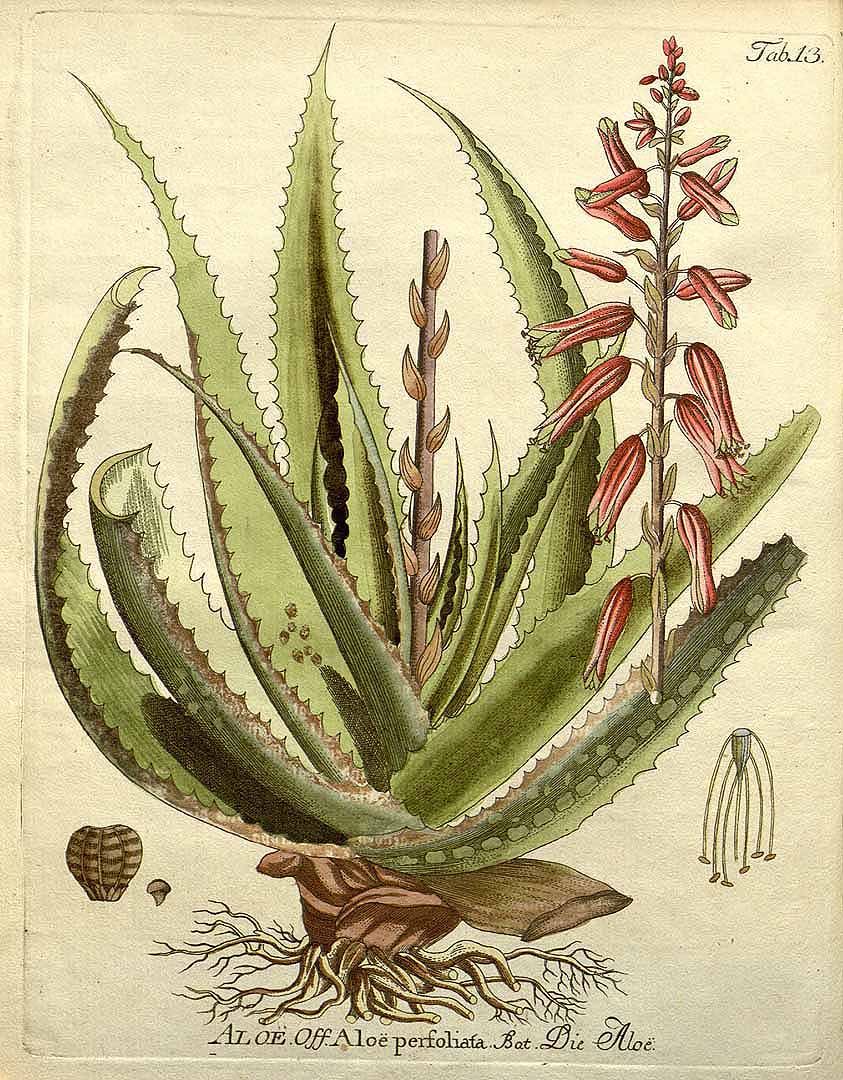
Aloe perfoliata, also known by the synonym Aloe mitriformis, is a rosette-forming succulent grown as a houseplant. Its fleshy, spiny, mid-green leaves take on red tones when the plant is under stress, and mature specimens can send up clusters of tubular red flowers on upright stems in winter.
Source: RHS
A Cape native, formally named
This plant's natural range lies in South Africa's Cape region. The name Aloe perfoliata was first published by Linnaeus in 1753, though botanical authorities now treat it as a synonym of Aloe microstigma, while a related name, Aloe perfoliata var. vera, is instead folded into Aloe vera.
Source: Kew
Sun, sparing water, summer feeding
Give this aloe full sun and a well-drained, loam-based or cacti potting compost, ideally with added horticultural grit. Water moderately while it is in growth and very sparingly once dormant in winter, and feed monthly with a general liquid fertiliser from May to August. It can be moved outdoors for the summer months.
Source: RHS
Seed or offsets
Propagate by sowing seed as soon as it is ripe, or by separating offsets in spring or early summer. Root the offsets in cactus potting compost.
Source: RHS
Modest indoors, sprawling in the wild
In tropical conditions this aloe can develop stems several metres long with leaves reaching 45cm, but as a houseplant it is unlikely to exceed 50cm in height. It forms clumps of evergreen, fleshy rosettes and carries its winter flowers on upright stems above the foliage.
Source: RHS
Scale and mealybug watch
Keep an eye out for scale insects and mealybugs, the two pests most likely to trouble this aloe. Otherwise it is generally free of disease.
Source: RHS
Little pruning needed
This aloe asks for no pruning. Its main seasonal adjustment is cutting back on water once the plant is dormant through winter.
Source: RHS
Care recipe
The species record — the baseline every cultivar inherits unless it says otherwise.
Care notes are early — not yet verified
- Light
- ai:claude-opus-4-8
- Water
- ai:claude-opus-4-8 (range 14-28d)
- Humidity
- ai:claude-opus-4-8
- Soil
- ai:claude-fable-5
- Care
- ai:claude-fable-5
Direct sun
≈ every 28 days
Low — average room
7–27 °C
Gritty, fast-draining cactus and succulent mix
Offsets or stem cuttings, dried before potting
Dilute succulent feed once or twice during the growing season
Slow
Coral-red spikes in strong light, uncommon indoors
Toxic to cats & dogs
Saponins + anthraquinones (the latex) — vomiting, lethargy, diarrhoea. This is where toxicity lives: every cultivar of this species inherits it and none can override it.
Reference images
Every image credited. Licenses link to their deeds.
PrimarySources: ai:claude-opus-4-8 · ai:claude-opus-4-8 (range 14-28d) · ai:claude-fable-5 · ASPCA
Kept true by its growers
Every fact here carries its source. Grow Mitra Aloe yourself? What you’ve observed — how it drinks, how it holds its color, a name that’s off — and a clear photo of your plant are exactly what keep this page honest. Contributions are reviewed before anything changes.
Sign in to add what you know →