Species · genus Aloe · Asphodelaceae
Tiger Tooth Aloe
Aloe juvenna Brandham & S.Carter
Cultivars of A. juvenna
The named forms growers keep — each with its own page, each honest about how much we know.
No named cultivars catalogued under A. juvenna yet. When growers document a stable, named form, it earns its own page here.
Guide
The species-level account. Cultivar pages build on this and say where they differ.
The Tiger Tooth Aloe
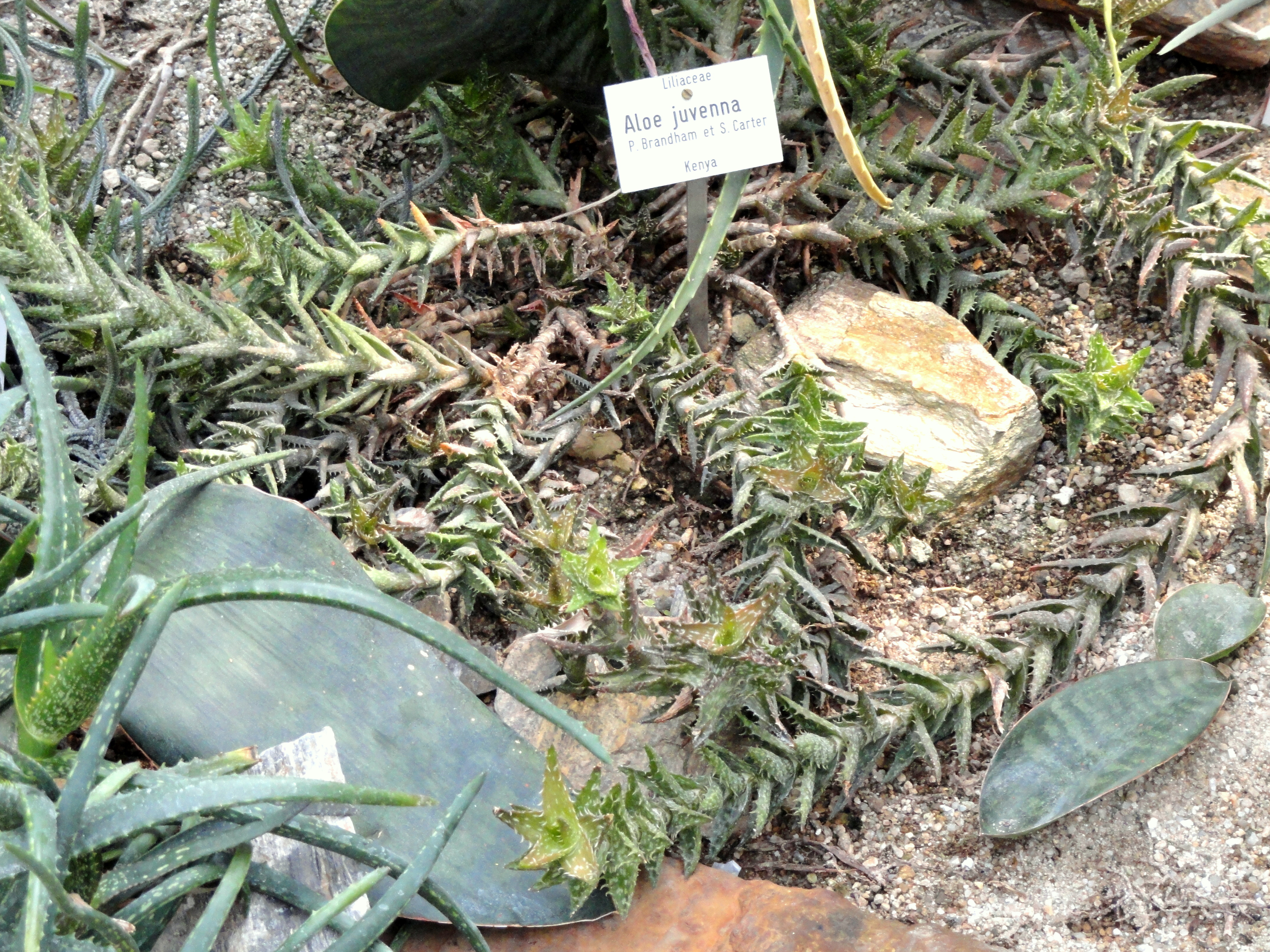
Aloe juvenna, commonly called tiger tooth aloe, is a small branching succulent that forms mounds of fleshy, tooth-edged leaves. It belongs to the Asphodelaceae family and is grown chiefly as a houseplant or conservatory subject.
Source: RHS
Native East African Range
This species comes from the wild, found naturally from southwest Kenya into northern Tanzania. There it grows as a succulent subshrub within a seasonally dry tropical landscape. It was first described in 1979 by Brandham and S. Carter.
Source: Kew
Light, Water, Feed
Give this aloe full sun, ideally a south- or west-facing spot, and pot it in a well-drained mix such as peat-free cacti compost or a loam-based compost with added grit. Water moderately through the growing season but hold back sharply in winter, when the plant rests. A general liquid fertiliser once a month from May to August covers its feeding needs, and it can be moved outdoors for the summer.
Source: RHS
Cuttings or Division
New plants come readily from stem cuttings or by dividing established clumps.
Source: RHS
Starry, Toothed Rosettes
The leaves are fleshy and green, edged with small teeth and marked with decorative white flecks, set in a starry pattern around the branching stems. Left to its own devices it spreads into low mounds no more than half a metre high or wide. In summer, slender stalks rise to about 25cm, carrying tubular flowers in shades of orange-red.
Source: RHS
Scale and Mealybugs
Watch for scale insects and mealybugs, the two pests most likely to trouble this aloe. The plant is otherwise generally free of disease.
Source: RHS
Little Upkeep Needed
No pruning is required for this species. It is a slow, steady grower, taking roughly two to five years to reach maturity.
Source: RHS
Care recipe
The species record — the baseline every cultivar inherits unless it says otherwise.
Care notes are early — not yet verified
- Light
- ai:claude-opus-4-8
- Water
- ai:claude-opus-4-8 (range 14-28d)
- Humidity
- ai:claude-opus-4-8
- Soil
- ai:claude-fable-5
- Care
- ai:claude-fable-5
Direct sun
≈ every 28 days
Low — average room
7–27 °C
Gritty, fast-draining cactus and succulent mix
Stem cuttings or offsets, dried a few days before potting
Dilute succulent feed once or twice in the growing season
Moderate
Rarely flowers indoors
Toxic to cats & dogs
Saponins + anthraquinones (the latex) — vomiting, lethargy, diarrhoea. This is where toxicity lives: every cultivar of this species inherits it and none can override it.
Reference images
Every image credited. Licenses link to their deeds.
PrimarySources: ai:claude-opus-4-8 · ai:claude-opus-4-8 (range 14-28d) · ai:claude-fable-5 · ASPCA
Kept true by its growers
Every fact here carries its source. Grow Tiger Tooth Aloe yourself? What you’ve observed — how it drinks, how it holds its color, a name that’s off — and a clear photo of your plant are exactly what keep this page honest. Contributions are reviewed before anything changes.
Sign in to add what you know →