Species · genus Alocasia · Araceae
Black Velvet Alocasia
Alocasia reginula A.Hay
Cultivars of A. reginula
The named forms growers keep — each with its own page, each honest about how much we know.
No named cultivars catalogued under A. reginula yet. When growers document a stable, named form, it earns its own page here.
Guide
The species-level account. Cultivar pages build on this and say where they differ.
A Borneo Collector's Alocasia
Alocasia reginula is a perennial aroid, sometimes traded as Alocasia reginae, grown as a compact subshrub prized for its foliage rather than its flowers. It belongs to the wet tropical understory plants of Borneo, and remains something of a collector's rarity.
Source: Kew
Native to Borneo
This species is native to Borneo, where it grows in the wet tropical biome as a perennial or subshrub. It was first described in the 1880s, though it has only recently become more available to home growers despite over a century of horticultural awareness.
Source: Costa Farms
Light, Water, and Humidity
Give it medium to bright indirect light, ideally within a few feet of an unobstructed east- or west-facing window, though it also does fine under artificial light. Let the top couple of inches of potting mix dry before watering again, since this aroid resents both drying out too far and sitting wet, either of which can turn leaves yellow or drop them. Average household humidity is tolerated, but it appreciates above-average moisture in the air, which can be offered by grouping plants together or growing it in a terrarium. Feed only in spring and summer with a houseplant fertilizer, following the label rate.
Source: Costa Farms
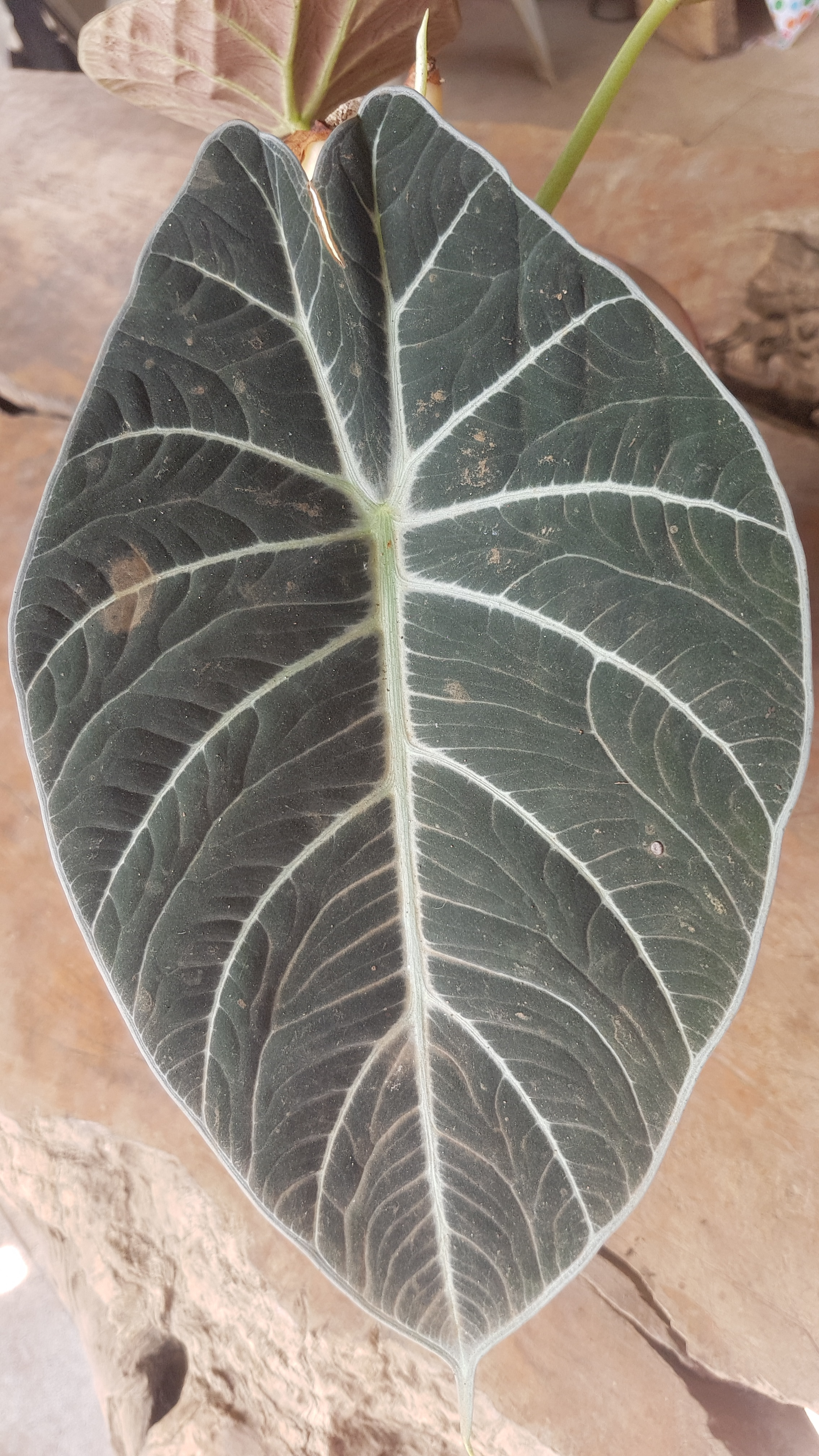
Silvery Velvet Foliage
Its thick, rubbery leaves carry a silvery blue-green cast on top, with darker veins adding contrast, while the undersides flush a striking reddish-purple. Leaves are slow to reach their full size, eventually approaching a foot long, and the plant itself stays compact, growing to roughly twelve inches tall and wide. It is sometimes called Silver Velvet Alocasia for this coloring, and is known as one parent of the hybrid Silver Streak.
Source: Costa Farms
Minimal Pruning Needed
This plant asks little in the way of trimming beyond removing old or damaged leaves as they appear.
Source: Costa Farms
Care recipe
The species record — the baseline every cultivar inherits unless it says otherwise.
Care notes are early — not yet verified
- Light
- ai:claude-opus-4-8
- Water
- ai:claude-opus-4-8 (range 5-10d)
- Humidity
- ai:claude-opus-4-8
- Soil
- ai:claude-fable-5
- Care
- ai:claude-fable-5
Bright, indirect
≈ every 10 days
High
18–29 °C
Very chunky, airy aroid mix that drains fast
Divide the small rhizome offsets carefully
Dilute balanced feed monthly while actively growing
Slow
Rarely flowers indoors; the 'Black Velvet' jewel
Toxic to cats & dogs & humans
Araceae contain insoluble calcium oxalate crystals, which irritate mouth and digestive tract if chewed. This is where toxicity lives: every cultivar of this species inherits it and none can override it.
Reference images
Every image credited. Licenses link to their deeds.
PrimarySources: ai:claude-opus-4-8 · ai:claude-opus-4-8 (range 5-10d) · ai:claude-fable-5 · ai:claude-opus-4-8 (family inference)
Kept true by its growers
Every fact here carries its source. Grow Black Velvet Alocasia yourself? What you’ve observed — how it drinks, how it holds its color, a name that’s off — and a clear photo of your plant are exactly what keep this page honest. Contributions are reviewed before anything changes.
Sign in to add what you know →