Species · genus Alocasia · Araceae
Tiger Taro
Alocasia longiloba Miq.
Also known as: Dragon Scale Alocasia · Alocasia Dragon Scale · Alocasia Tigrina · Spotted Alocasia
Cultivars of A. longiloba
The named forms growers keep — each with its own page, each honest about how much we know.
No named cultivars catalogued under A. longiloba yet. When growers document a stable, named form, it earns its own page here.
Guide
The species-level account. Cultivar pages build on this and say where they differ.
An Elephant's Ear Aroid
Alocasia longiloba belongs to the arum family, the same lineage that gives us peace lilies and the Swiss cheese plant. It is one of many alocasias grown for their bold, shield-shaped leaves rather than for flowers, which are modest by comparison.
Source: RHS
A Wide Native Range
This species is native across a broad sweep of Asia, from southern China through Myanmar, Thailand, Laos, Cambodia and Vietnam, down into Malaya and islands including Borneo, Sumatra, Java and Sulawesi. It grows as a subshrub in wet tropical forest, and was first published under this name by Miquel in 1856. Over the years it has accumulated a long list of synonyms, a sign of how often collectors and botanists described the same plant under different names.
Source: Kew
Warmth, Light, and Rhythm
Give this plant bright but indirect light, since strong sun scorches the foliage while too little slows growth considerably. Keep it warm, above 16°C through the growing season, water once the top of the compost has dried, and feed with a general liquid fertiliser from April to October. It also appreciates medium to high humidity, best supplied with a gravel tray, misting, grouping plants together, or a humidifier.
Source: RHS
Offsets and Rhizome Division
The simplest method is to separate offsets that form around the base of a mature plant in spring, slicing them free with as much root as possible and potting them individually in gritty, peat-free compost. Alternatively, the fleshy rhizome can be divided in late spring or early summer, with the pieces kept warm and in good light until new shoots appear. Gloves are worth wearing throughout, since the sap can irritate skin.
Source: RHS
Big Leaves, Bold Veins
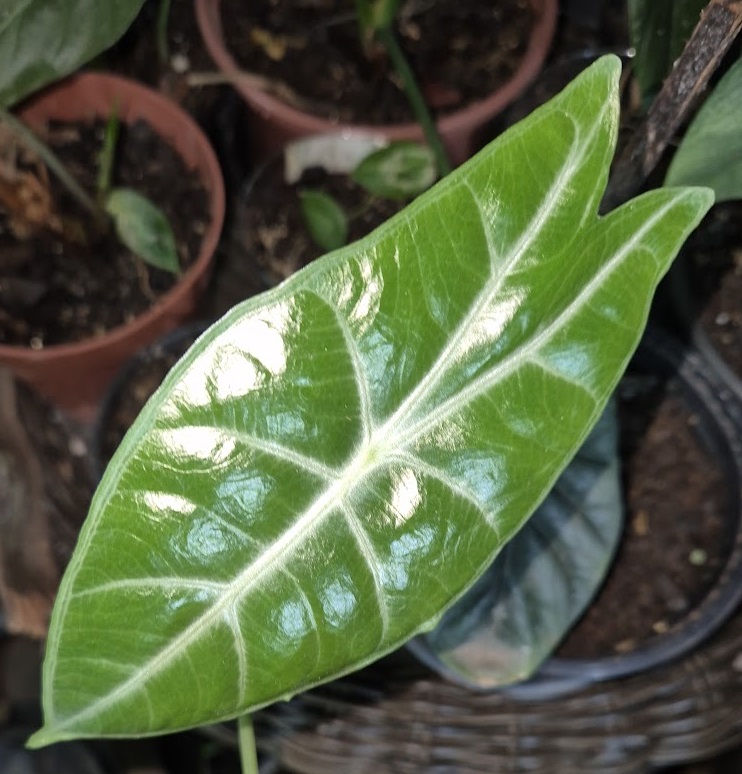
Like other alocasias, this plant carries large, usually peltate leaves marked with conspicuous veining, an architecture built to gather light beneath a forest canopy. Insignificant spathes may appear, occasionally followed by orange-red fruits, though the leaves remain the main attraction.
Source: RHS
Dry Air Invites Mites
Low humidity is the main trigger for trouble, causing browning at the leaf edges and making the plant more attractive to red spider mites, which favour a dry atmosphere.
Source: RHS
Overwatering and Cold
Most problems trace back to a handful of avoidable conditions: overwatering, particularly through winter dormancy, which leads to root rot; cold draughts; and temperatures dropping below 10°C, or below 16°C during the growing season. Given warmth, humidity, water and feed through the growing season followed by a cooler, drier winter rest, the plant is usually vigorous and robust.
Source: RHS
A Winter Rest
Repot every couple of years, or check sooner if growth is fast, moving up only about 5cm in pot diameter at a time and using a peat-free compost loosened with grit. In winter the plant wants to go dormant, kept cooler and drier though never below 10°C, and it may shed some leaves then without cause for alarm. Pruning is otherwise limited to cutting away fading or dead leaves at the base, always with gloves on given the irritant sap.
Source: RHS
Care recipe
The species record — the baseline every cultivar inherits unless it says otherwise.
Care notes are early — not yet verified
- Light
- ai:claude-opus-4-8
- Water
- ai:claude-opus-4-8 (range 7-12d)
- Humidity
- ai:claude-opus-4-8
- Soil
- ai:claude-fable-5
- Care
- ai:claude-fable-5
Bright, indirect
≈ every 12 days
High
18–29 °C
Loose, well-draining bark-based aroid mix
Separate rhizome offsets or divisions
Light balanced feed monthly in the growing season
Moderate
Rarely flowers indoors
Toxic to cats & dogs & humans
Araceae contain insoluble calcium oxalate crystals, which irritate mouth and digestive tissue if chewed. This is where toxicity lives: every cultivar of this species inherits it and none can override it.
Reference images
Every image credited. Licenses link to their deeds.
PrimarySources: ai:claude-opus-4-8 · ai:claude-opus-4-8 (range 7-12d) · ai:claude-fable-5 · ai:claude-opus-4-8 (family inference)
Kept true by its growers
Every fact here carries its source. Grow Tiger Taro yourself? What you’ve observed — how it drinks, how it holds its color, a name that’s off — and a clear photo of your plant are exactly what keep this page honest. Contributions are reviewed before anything changes.
Sign in to add what you know →