Species · genus Alocasia · Araceae
Cunjevoi
Alocasia brisbanensis (F.M.Bailey) Domin
Cultivars of A. brisbanensis
The named forms growers keep — each with its own page, each honest about how much we know.
No named cultivars catalogued under A. brisbanensis yet. When growers document a stable, named form, it earns its own page here.
Guide
The species-level account. Cultivar pages build on this and say where they differ.
A rainforest aroid
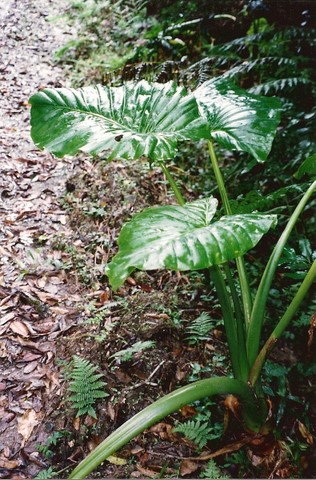
Alocasia brisbanensis is a rhizomatous evergreen perennial grown as a foliage plant, valued for its large, glossy, spade-shaped leaves. It carries fragrant green-cream flowers in summer, arum-like in form, followed by spikes of red berries.
Source: RHS
Out of eastern Australia
This species belongs to the arum family, Araceae, and was first described under its current name in 1915. It is native to the rainforests of north and east Queensland through to eastern New South Wales, growing there as a subshrub or shrub, and it has since become introduced in the Kermadec Islands and the North Island of New Zealand.
Source: Kew
Warmth, light, and moisture
Indoors, give it bright, indirect light and a peat-free houseplant compost with added perlite for drainage. Water freely through the growing season and feed with a general liquid fertiliser every two to three weeks from spring to autumn, while standing the pot on moist gravel or pebbles to keep humidity up. In winter, cut watering back to a minimum and keep the plant above 15°C.
Source: RHS
Dividing offsets
New plants are raised by dividing the offsets that form at the base of the parent plant.
Source: RHS
Bold, rippled foliage
The plant is bushy and clump-forming, with large, rippled, spade-shaped dark green leaves held glossy on dark green stems. It can reach one to one and a half metres in both height and spread. Its flowers are notably fragrant for an aroid, and are followed by clusters of red berries on spikes.
Source: RHS
Aphids and caterpillars
The main pests to watch for are aphids and caterpillars; otherwise the plant is generally free of disease.
Source: RHS
Little upkeep needed
No pruning is required for this species. It is worth noting that all parts are toxic if eaten and can irritate skin and eyes, so gloves are sensible when handling it, and it should be kept away from pets.
Source: RHS
Care recipe
The species record — the baseline every cultivar inherits unless it says otherwise.
Care notes are early — not yet verified
- Light
- ai:claude-opus-4-8
- Water
- ai:claude-opus-4-8 (range 7-12d)
- Humidity
- ai:claude-opus-4-8
- Soil
- ai:claude-fable-5
- Care
- ai:claude-fable-5
Bright, indirect
≈ every 12 days
High
16–30 °C
Rich, well-draining mix with bark and perlite
Divide rhizome offsets at repotting
Balanced liquid feed monthly while actively growing
Moderate
Produces a greenish spathe occasionally; grown for foliage
Toxic to cats & dogs & humans
Araceae contain insoluble calcium oxalate crystals, which irritate the mouth and digestive tract if chewed. This is where toxicity lives: every cultivar of this species inherits it and none can override it.
Reference images
Every image credited. Licenses link to their deeds.
PrimarySources: ai:claude-opus-4-8 · ai:claude-opus-4-8 (range 7-12d) · ai:claude-fable-5 · ai:claude-opus-4-8 (family inference)
Kept true by its growers
Every fact here carries its source. Grow Cunjevoi yourself? What you’ve observed — how it drinks, how it holds its color, a name that’s off — and a clear photo of your plant are exactly what keep this page honest. Contributions are reviewed before anything changes.
Sign in to add what you know →