Species · genus Agave · Asparagaceae
Tequila Agave
Agave tequilana F.A.C.Weber
Also known as: Blue Agave
Cultivars of A. tequilana
The named forms growers keep — each with its own page, each honest about how much we know.
No named cultivars catalogued under A. tequilana yet. When growers document a stable, named form, it earns its own page here.
Guide
The species-level account. Cultivar pages build on this and say where they differ.
The tequila-making agave
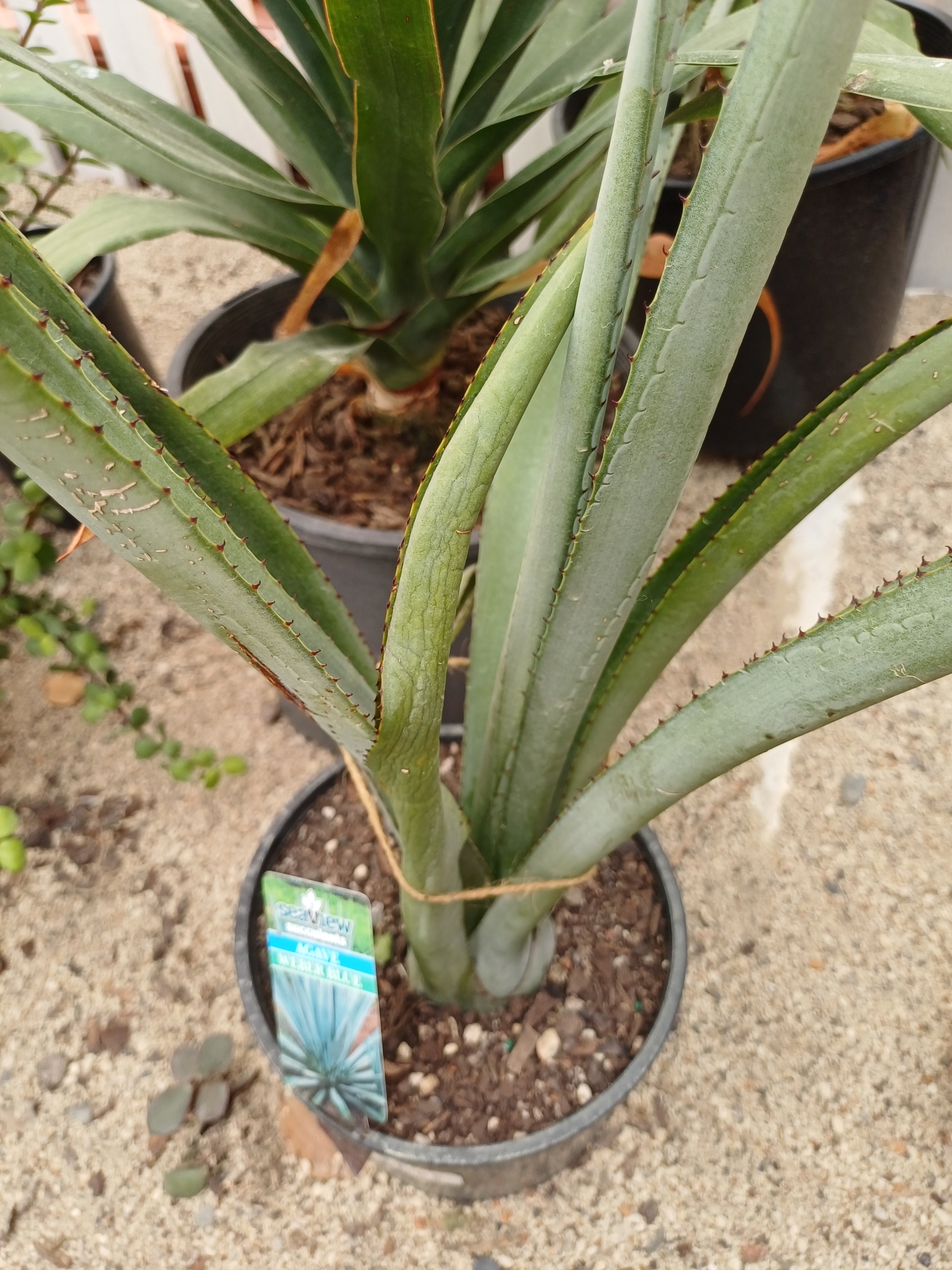
Agave tequilana, known as blue agave, is a large succulent from the family Asparagaceae, best known as the plant behind Mexico's famous spirit, tequila. It is a spikey, blue-grey rosette plant, grown at scale for its dense, fleshy heart rather than for the pot.
Source: Kew
Jalisco's tequila fields
Blue agave is native to west and central Mexico, and it is around the town of Tequila in the state of Jalisco that the plant gives the drink its name. Growers there farm thousands of plants above 1,500m, in mineral-rich, loamy soils across semi-dry terrain. The name agave itself traces back to the Ancient Greek 'agauos', meaning noble.
Source: Kew
Rosette, spines, and flower spike
This is a large succulent forming a rosette of fleshy, spine-edged leaves. The 'Weber Azul' variety grown for tequila reaches around 2m tall with blue-grey leaves, while a second, lesser-known blue agave form stays smaller with green leaves. After about five years the plant sends up a flowering stalk that can climb to 5m, topped with yellow blooms, after which the rosette itself is spent.
Source: Kew
Narrow genetics, greater risk
Commercial tequila production leans almost entirely on a single blue agave variety, Weber Azul, and that narrow genetic base leaves the species more exposed to pests and disease. It is a reminder that a plant grown so uniformly loses some of its natural resilience.
Source: Kew
Harvest ends the plant's life
In cultivation for tequila, blue agave is harvested rather than pruned: jimadores use a tool called a coa to strip away the leaves and expose the piña, the dense core at the plant's centre. This harvest is the plant's endpoint, since the piña is what gets baked, pulped, and juiced for fermentation and distillation.
Source: Kew
Care recipe
The species record — the baseline every cultivar inherits unless it says otherwise.
Care notes are early — not yet verified
- Light
- ai:claude-opus-4-8
- Water
- ai:claude-opus-4-8 (range 14-30d)
- Humidity
- ai:claude-opus-4-8
- Soil
- ai:claude-fable-5
- Care
- ai:claude-fable-5
Direct sun
≈ every 30 days
Low — average room
5–35 °C
Gritty, sharply draining succulent mix
Offsets removed from the base
Dilute feed once or twice in spring and summer
Moderate
Rarely indoors; blooms once after many years, then dies
Not yet documented
This is where toxicity lives — every cultivar of this species inherits it and none can override it.
Reference images
Every image credited. Licenses link to their deeds.
PrimarySources: ai:claude-opus-4-8 · ai:claude-opus-4-8 (range 14-30d) · ai:claude-fable-5
Kept true by its growers
Every fact here carries its source. Grow Tequila Agave yourself? What you’ve observed — how it drinks, how it holds its color, a name that’s off — and a clear photo of your plant are exactly what keep this page honest. Contributions are reviewed before anything changes.
Sign in to add what you know →