Species · genus Aeschynanthus · Gesneriaceae
Lipstick Plant
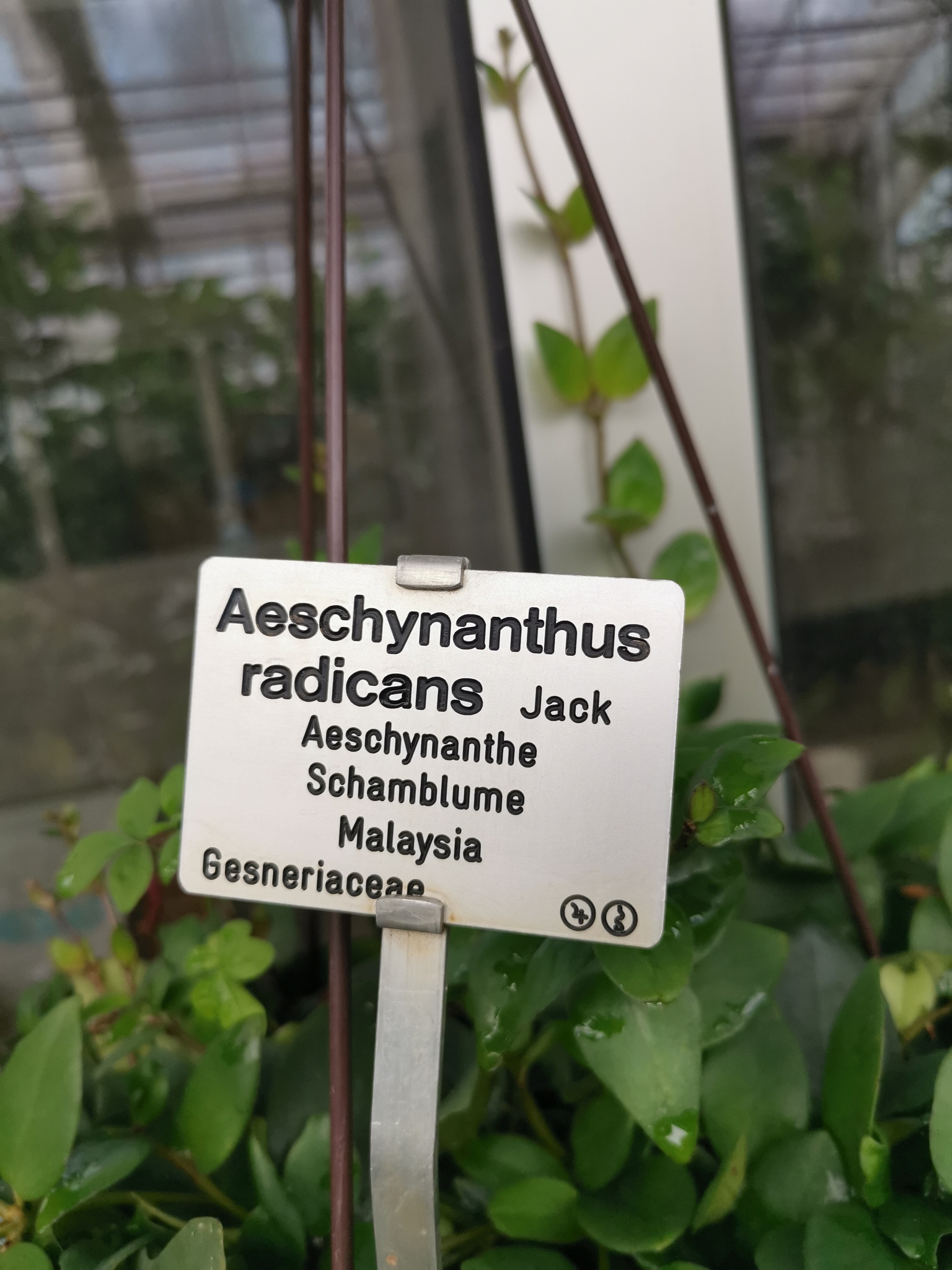
Aeschynanthus radicans Jack
Also known as: Lipstick Vine
Cultivars of A. radicans
The named forms growers keep — each with its own page, each honest about how much we know.
No named cultivars catalogued under A. radicans yet. When growers document a stable, named form, it earns its own page here.
Guide
The species-level account. Cultivar pages build on this and say where they differ.
The Lipstick Plant
Lipstick plant is a trailing tropical evergreen grown for its glossy, fleshy foliage and its tubular flowers, which push out of dark, cigar-like calyxes much like a tube of lipstick emerging from its case. It's sold both as Aeschynanthus radicans and under various Aeschynanthus cultivar names, and it does double duty as a foliage plant and a bloomer.
Source: Costa Farms
A Malesian Epiphyte
This plant hails from the Malay Peninsula, spanning Malaysia, Thailand, and Myanmar, where it grows as an evergreen perennial. In the wild it lives as an epiphyte, its trailing and arching stems originating from tree branches in damp forest rather than from soil. That epiphytic history is worth remembering indoors, since it explains why the plant appreciates airy, well-drained footing over dense, wet soil.
Source: Missouri Botanical Garden
Light, Water, Feeding
Give this plant bright, filtered light rather than harsh direct sun; a partially shaded position with good general brightness suits it, and it will not do well in deep shade. Water freely enough to keep the compost moist, cutting back to sparing watering over winter, and feed monthly with a half-strength general liquid feed from mid spring to late summer to support flowering. It is not fussy about soil pH but wants something moisture-retentive yet well-drained.
Source: RHS
Rooting from Cuttings
Lipstick plant is propagated from stem cuttings, taken just below a leaf node and set in a glass of water until roots form over a few weeks. Dipping the cut end in rooting hormone can speed things along, though it isn't essential. Once rooted, the new plant can go into potting medium and be watered regularly until fresh growth appears. The RHS notes this can also be done as softwood cuttings in spring or semi-ripe cuttings in summer.
Source: Epic Gardening
Leathery Leaves, Tube Flowers
The leaves are dark green, elliptical, fleshy, and smooth-edged, giving the whole plant a slightly succulent look, while the flowers are long, red, and tubular, gathered into dense clusters at the stem tips. The genus name itself nods to this bloom: it comes from Greek words for shame and flower, a reference to the red color, while the species name simply means rooting stems. Growers have selected a wide range of forms beyond the plain green-and-red type, including variegated leaves, curled or twisted foliage, and flowers ranging into orange, yellow, and purple tones.
Source: Missouri Botanical Garden
Common Pests to Watch
Aphids, mealybugs, and spider mites are the main pests to watch for. Aphids can be knocked off with a forceful spray of water or wiped away, with neem oil as a backup for heavier infestations; mealybugs show up as pale leaves with a cottony mass and respond to insecticidal soap. Spider mites prefer warm, dry, low-humidity conditions and first appear as tiny holes or yellowish spots on foliage, so raising humidity is a useful preventative alongside water sprays or insecticidal soap for worse cases.
Source: Epic Gardening
Reading the Leaves
Too much direct sun tends to show up as leaf drop or scorching, while a plant that won't flower and grows slowly is usually asking for more light. Overly wet, soggy soil invites root rot, seen as a soft mushy stem, wilting, and leaf drop, though a plant can sometimes be saved by trimming away rotted roots and repotting into dry soil. Leaf spot is another fungal issue, best prevented by watering at the base rather than wetting the foliage.
Source: Epic Gardening
Pruning and Repotting
As a prolific bloomer, lipstick plant will sprawl if left unchecked, so prune back scraggly vines for bushier growth and deadhead spent flowers to encourage more buds. Once flowering finishes, cut the plant back to about 6 inches to spur healthy new growth and another flush of blooms. Repot roughly every 2 to 3 years, moving up just 1 to 2 inches in pot size, ideally after flowering has wrapped up for the season in fall or winter.
Source: Epic Gardening
Care recipe
The species record — the baseline every cultivar inherits unless it says otherwise.
Not documented
Not documented
Not documented
Not documented
Not documented
Not documented
Not documented
Not documented
Not documented
Not yet documented
This is where toxicity lives — every cultivar of this species inherits it and none can override it.
Reference images
Every image credited. Licenses link to their deeds.
PrimarySources: Awaiting its first cited source.
Kept true by its growers
Every fact here carries its source. Grow Lipstick Plant yourself? What you’ve observed — how it drinks, how it holds its color, a name that’s off — and a clear photo of your plant are exactly what keep this page honest. Contributions are reviewed before anything changes.
Sign in to add what you know →