Species · genus Aechmea · Bromeliaceae
Matchstick Plant
Aechmea gamosepala Wittm.
Also known as: Matchstick Bromeliad
Cultivars of A. gamosepala
The named forms growers keep — each with its own page, each honest about how much we know.
No named cultivars catalogued under A. gamosepala yet. When growers document a stable, named form, it earns its own page here.
Guide
The species-level account. Cultivar pages build on this and say where they differ.
A Bromeliad Rosette
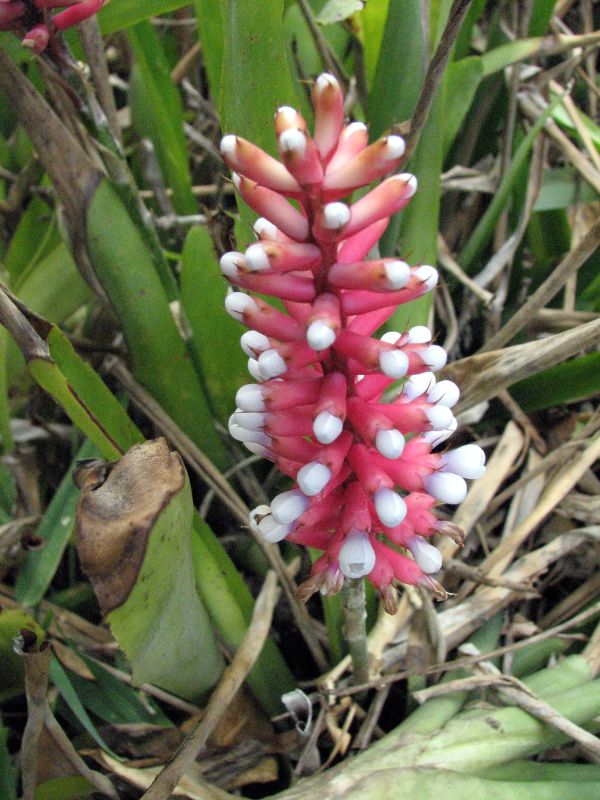
Aechmea gamosepala is an evergreen perennial bromeliad, part of a genus known for funnel-shaped rosettes of strap-shaped leaves. It sends up a terminal flower spike, typically backed by colourful triangular bracts, and later fleshy fruits.
Source: RHS
Brazilian Epiphyte Roots
This species comes from southeastern and southern Brazil, where it grows as an epiphyte, rooted not in soil but on other plants. Its native habitat sits within a seasonally dry tropical biome. It was first described by Wittmack in 1891.
Source: Kew
Rosette, Spike, Variety
Like other Aechmeas, this plant holds its strap-shaped leaves in a funnel, a form built to catch and hold water at its centre. The flower spike is tubular and set off by bracts, followed by fleshy fruit. A recognised variety, Aechmea gamosepala var. nivea, exists alongside the typical form.
Source: Kew
Care recipe
The species record — the baseline every cultivar inherits unless it says otherwise.
Care notes are early — not yet verified
- Light
- ai:claude-opus-4-8
- Water
- ai:claude-opus-4-8 (range 7-14d)
- Humidity
- ai:claude-opus-4-8
- Soil
- ai:claude-fable-5
- Care
- ai:claude-fable-5
Bright, indirect
≈ every 14 days
Medium
12–28 °C
Loose, fast-draining bromeliad or orchid mix
Divide the readily produced offsets
Dilute liquid feed monthly during spring and summer
Slow
Coral-pink bracts with blue flowers, a free bloomer indoors
Not yet documented
This is where toxicity lives — every cultivar of this species inherits it and none can override it.
Reference images
Every image credited. Licenses link to their deeds.
PrimarySources: ai:claude-opus-4-8 · ai:claude-opus-4-8 (range 7-14d) · ai:claude-fable-5
Kept true by its growers
Every fact here carries its source. Grow Matchstick Plant yourself? What you’ve observed — how it drinks, how it holds its color, a name that’s off — and a clear photo of your plant are exactly what keep this page honest. Contributions are reviewed before anything changes.
Sign in to add what you know →