Species · genus Aechmea · Bromeliaceae
Vase Bromeliad
Aechmea bracteata (Sw.) Griseb.
Cultivars of A. bracteata
The named forms growers keep — each with its own page, each honest about how much we know.
No named cultivars catalogued under A. bracteata yet. When growers document a stable, named form, it earns its own page here.
Guide
The species-level account. Cultivar pages build on this and say where they differ.
An Epiphytic Bromeliad
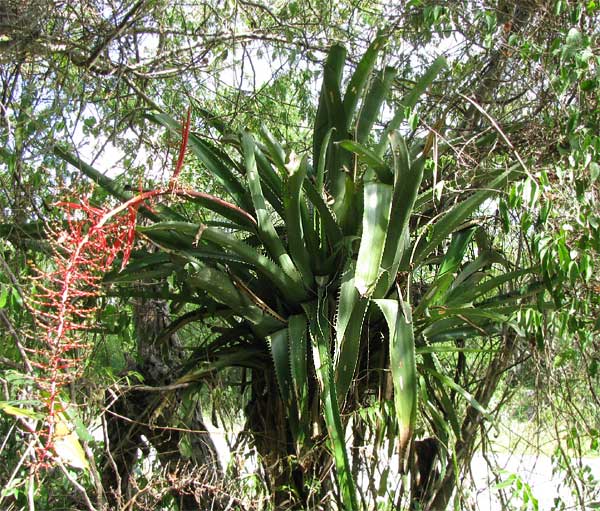
Aechmea bracteata is a bromeliad species belonging to the family Bromeliaceae. It grows as an epiphyte, meaning it takes hold on other plants rather than rooting in soil, and in the wild it has also been used as a food source.
Source: Kew
From Mexico to Venezuela
This species is native to a broad swath of Central America and northern South America, ranging from Mexico down through Belize, Guatemala, Honduras, Nicaragua, Costa Rica, and Panama, into Colombia and northwestern Venezuela. It has also become established beyond its native range in the Bahamas. In the wild it favours seasonally dry tropical settings, growing perched on other plants rather than in the ground.
Source: Kew
Rosette, Bracts, and Berries
As a member of the genus Aechmea, this plant forms an evergreen, funnel-shaped rosette of strap-like leaves. From the centre rises a terminal flower spike bearing tubular blooms, often set off by colourful triangular bracts, and these are followed by fleshy fruits.
Source: RHS
Care recipe
The species record — the baseline every cultivar inherits unless it says otherwise.
Care notes are early — not yet verified
- Light
- ai:claude-opus-4-8
- Water
- ai:claude-opus-4-8 (range 7-14d)
- Humidity
- ai:claude-opus-4-8
- Soil
- ai:claude-fable-5
- Care
- ai:claude-fable-5
Bright, indirect
≈ every 14 days
High
15–30 °C
Loose, fast-draining bromeliad mix
Offsets (pups) removed after flowering
Dilute feed sparingly during active growth
Moderate
Branched, long-lasting inflorescence when mature
Not yet documented
This is where toxicity lives — every cultivar of this species inherits it and none can override it.
Reference images
Every image credited. Licenses link to their deeds.
PrimarySources: ai:claude-opus-4-8 · ai:claude-opus-4-8 (range 7-14d) · ai:claude-fable-5
Kept true by its growers
Every fact here carries its source. Grow Vase Bromeliad yourself? What you’ve observed — how it drinks, how it holds its color, a name that’s off — and a clear photo of your plant are exactly what keep this page honest. Contributions are reviewed before anything changes.
Sign in to add what you know →