Species · genus Acalypha · Euphorbiaceae
Chenilleplant
Acalypha hispida Burm.f.
Also known as: Philippine-medusa · Red-cattail · Red-Hot Cat's Tail · Red-hot-cattail · Bristly Copperleaf
Cultivars of A. hispida
The named forms growers keep — each with its own page, each honest about how much we know.
No named cultivars catalogued under A. hispida yet. When growers document a stable, named form, it earns its own page here.
Guide
The species-level account. Cultivar pages build on this and say where they differ.
Chenille Plant, Introduced
Acalypha hispida, commonly called red-hot cat's tail or chenille plant, is an evergreen shrub grown for its long, fuzzy, tail-like flowerheads rather than for foliage alone. It belongs to the spurge family and holds the RHS Award of Garden Merit as a conservatory or greenhouse shrub.
Source: RHS
Native Range
This shrub's natural range lies in New Guinea and Malaya, and it belongs to the genus Acalypha, whose members include evergreen shrubs, trees, and annuals bearing catkin-like flower racemes. It is not native to Britain or Ireland, and in UK conditions it is grown under glass or brought outside only in summer.
Source: RHS
Light, Water, Feed
Grow it under glass or indoors in a peat-free compost, in full or filtered light, with a sheltered spot facing south or east. While it is actively growing, water freely and feed monthly with a balanced liquid fertiliser, then cut back to sparing, barely-moist watering over winter. Where climate allows outdoors, it wants fertile, humus-rich, moist but well-drained soil in sun or part shade.
Source: RHS
Cuttings With Bottom Heat
Propagation is by softwood cuttings taken in early spring or semi-hardwood cuttings in late summer. Either way, bottom heat is needed to get them going.
Source: RHS
Fluffy Red Catkins
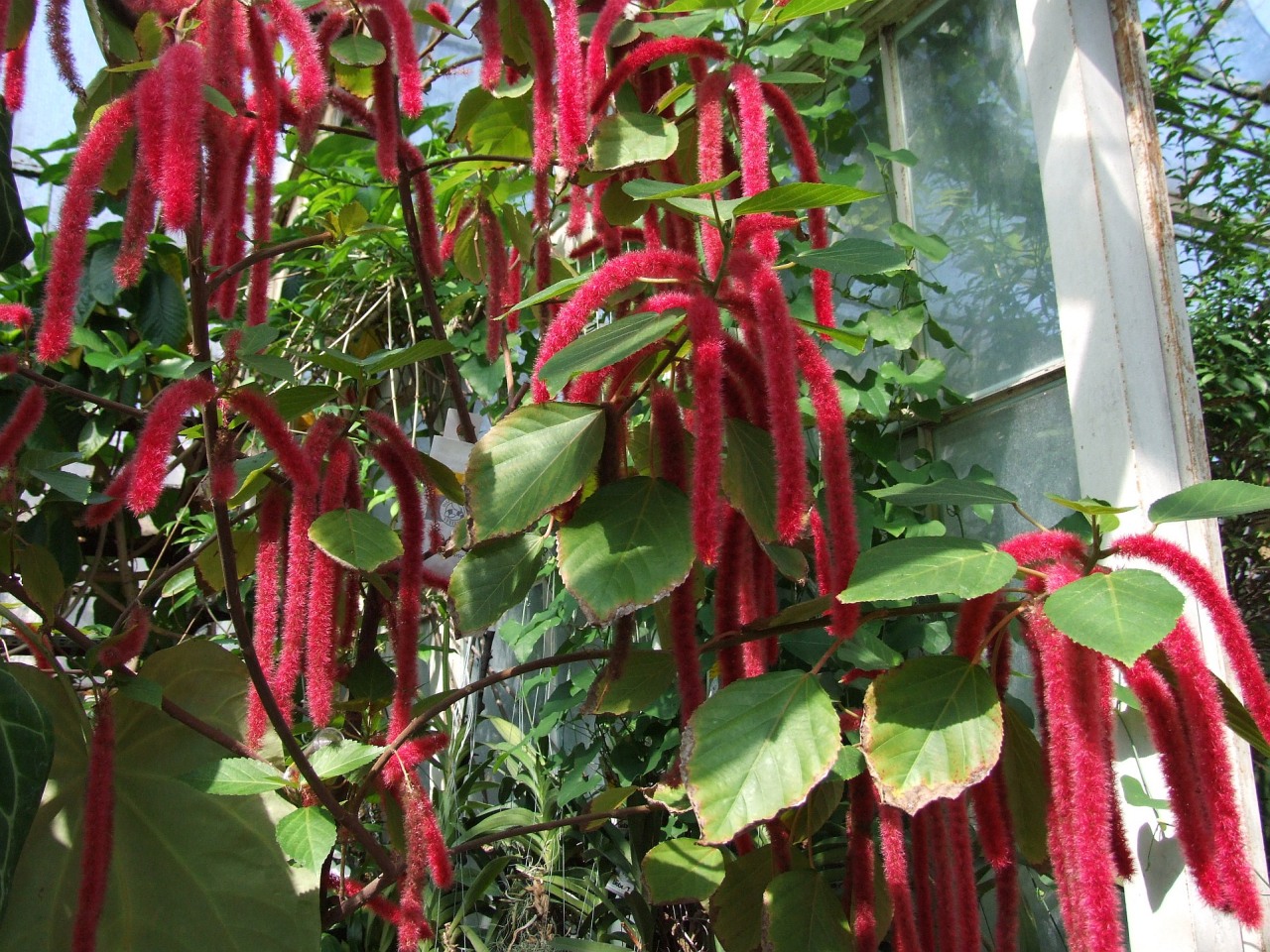
The plant grows erect and bushy, reaching as much as 2.5 metres tall with large ovate leaves. Its signature feature is the pendulous, fluffy, red catkin-like flowerhead, which can trail to 45 centimetres and appears sporadically through the year.
Source: RHS
Glasshouse Regulars
Under glass or indoors this plant can attract glasshouse whitefly, glasshouse red spider mite, mealybugs, and scale insects. It is otherwise generally free of disease.
Source: RHS
Pruning and Pace
This shrub falls into pruning group 10 and is considered a low-maintenance choice. It takes its time to reach full size, with a maturity span of some ten to twenty years.
Source: RHS
Care recipe
The species record — the baseline every cultivar inherits unless it says otherwise.
Care notes are early — not yet verified
- Light
- ai:claude-opus-4-8
- Water
- ai:claude-opus-4-8 (range 5-10d)
- Humidity
- ai:claude-opus-4-8
- Soil
- ai:claude-fable-5
- Care
- ai:claude-fable-5
Bright, indirect
≈ every 10 days
High
16–29 °C
Rich, moisture-retentive well-draining mix
Softwood stem cuttings under warmth and humidity
Balanced liquid feed every 2-4 weeks while growing
Fast
Long fuzzy red catkins — the signature chenille tassels
Toxic to cats & dogs & humans
Euphorbiaceae commonly produce an irritant milky latex that can cause skin, eye, and gastrointestinal irritation. This is where toxicity lives: every cultivar of this species inherits it and none can override it.
Reference images
Every image credited. Licenses link to their deeds.
PrimarySources: ai:claude-opus-4-8 · ai:claude-opus-4-8 (range 5-10d) · ai:claude-fable-5 · ai:claude-opus-4-8 (family inference)
Kept true by its growers
Every fact here carries its source. Grow Chenilleplant yourself? What you’ve observed — how it drinks, how it holds its color, a name that’s off — and a clear photo of your plant are exactly what keep this page honest. Contributions are reviewed before anything changes.
Sign in to add what you know →