Species · genus Acalypha · Euphorbiaceae
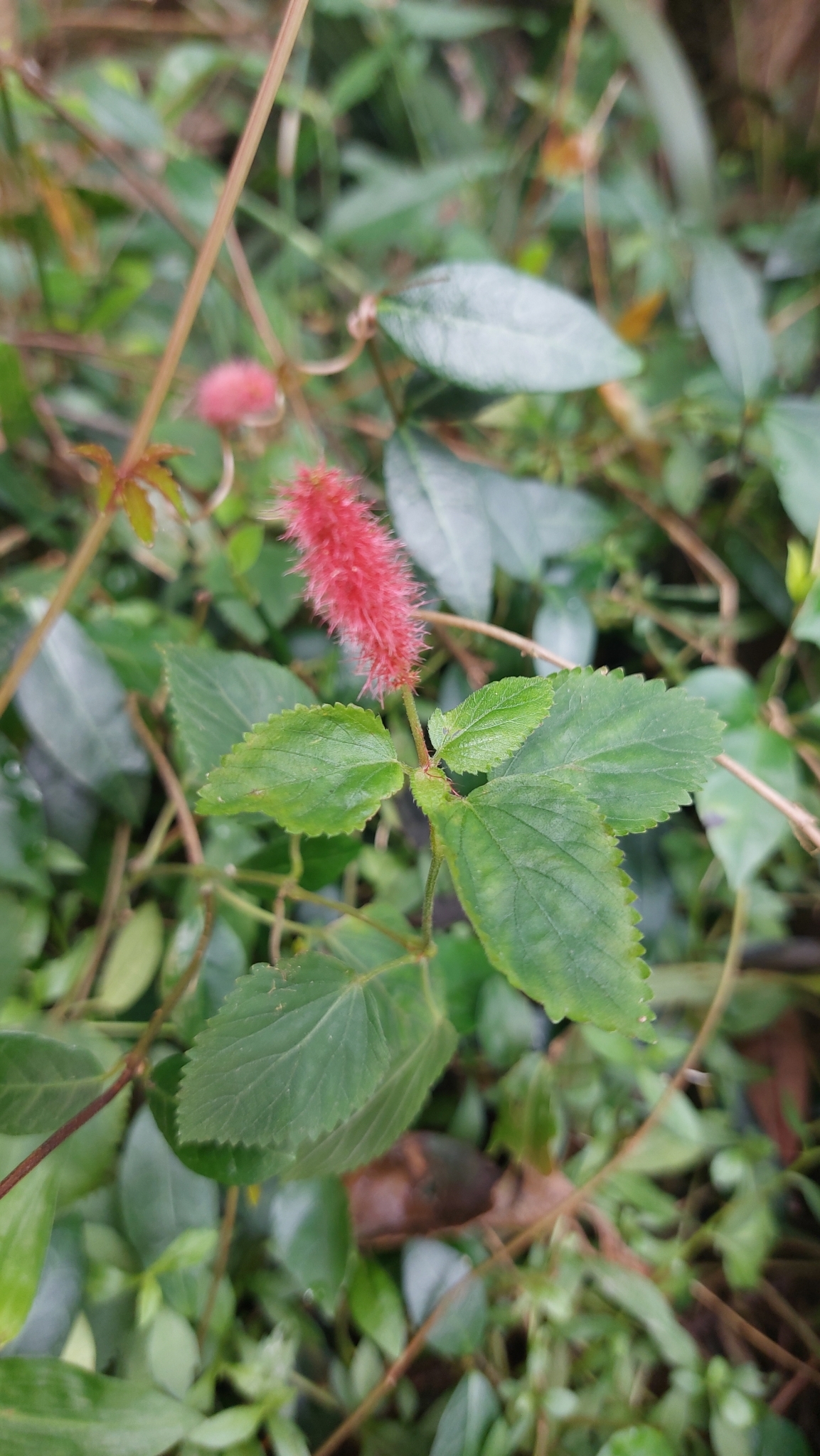
Dwarf Chenilleplant
Acalypha herzogiana Pax & K.Hoffm.
Also known as: Dwarf-cattail · Red Firetail · Strawberry Firetail · Strawberry-foxtail · Trailing Chenilleplant
Cultivars of A. herzogiana
The named forms growers keep — each with its own page, each honest about how much we know.
No named cultivars catalogued under A. herzogiana yet. When growers document a stable, named form, it earns its own page here.
Guide
The species-level account. Cultivar pages build on this and say where they differ.
A Little-Known Subshrub
Acalypha herzogiana is a subshrub in the Euphorbiaceae family, the same family that gives us the more familiar copperleaf and chenille plants. It carries the botanical name given by Pax and K.Hoffmann, first published in 1921.
Source: Kew
South American Roots
This plant is native to Bolivia, southeastern and southern Brazil, Paraguay, and northeastern Argentina. It grows primarily within the wet tropical biome of that region, and has also become introduced in Alabama.
Source: Kew
A Catkin-Bearing Genus
As a member of Acalypha, this plant belongs to a genus of evergreen shrubs, trees, or annuals bearing simple leaves and catkin-like racemes of tiny flowers, which in some species are brightly coloured. In the trade it has sometimes circulated under the misapplied names Acalypha reptans or Acalypha pendula, though herzogiana is its correct and accepted name.
Source: RHS
Care recipe
The species record — the baseline every cultivar inherits unless it says otherwise.
Care notes are early — not yet verified
- Light
- ai:claude-opus-4-8
- Water
- ai:claude-opus-4-8 (range 7-12d)
- Humidity
- ai:claude-opus-4-8
- Soil
- ai:claude-fable-5
- Care
- ai:claude-fable-5
Bright, indirect
≈ every 12 days
Medium
16–29 °C
Rich, well-draining loamy potting mix
Softwood stem cuttings rooted in warmth
Balanced liquid feed monthly in the growing season
Fast
Small catkin-like blooms, uncommon indoors
Toxic to cats & dogs & humans
Euphorbiaceae commonly carry an irritant milky latex that can harm skin, eyes, and mucous membranes if cut or chewed. This is where toxicity lives: every cultivar of this species inherits it and none can override it.
Reference images
Every image credited. Licenses link to their deeds.
PrimarySources: ai:claude-opus-4-8 · ai:claude-opus-4-8 (range 7-12d) · ai:claude-fable-5 · ai:claude-opus-4-8 (family inference)
Kept true by its growers
Every fact here carries its source. Grow Dwarf Chenilleplant yourself? What you’ve observed — how it drinks, how it holds its color, a name that’s off — and a clear photo of your plant are exactly what keep this page honest. Contributions are reviewed before anything changes.
Sign in to add what you know →